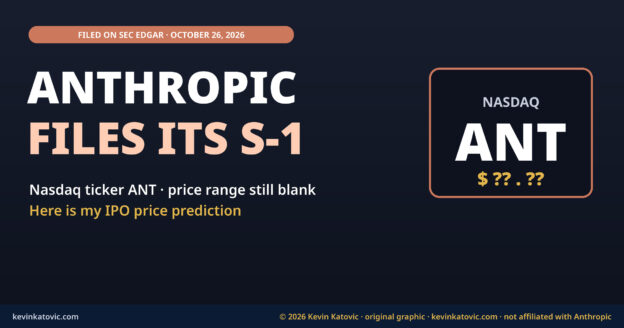
It finally happened. On Monday morning, October 26, 2026, Anthropic filed its S-1 publicly with the SEC, 147 days after the confidential draft. The ticker is ANT, the exchange is Nasdaq, and the one number everybody wants, the price, is still blank. So here is what the filing actually says, and my own prediction for what ANT will price at.
What the Anthropic S-1 confirms
I read the filing on SEC EDGAR the morning it landed (search “Anthropic, PBC”, CIK 0002130357). The headline facts:
- Ticker and exchange: Class A common stock on the Nasdaq Global Select Market under the symbol ANT.
- Price and size: blank. No price range, no share count, no dollar amount yet. Those come in an amended S-1.
- Banks: Goldman Sachs and Morgan Stanley first on the cover, then J.P. Morgan, Citigroup, Barclays and Wells Fargo, 22 banks in all.
- A 10-for-1 stock split already happened on September 17, 2026, so older per-share numbers floating around the internet are out of date.
The money: big revenue, a scary loss that mostly isn’t cash
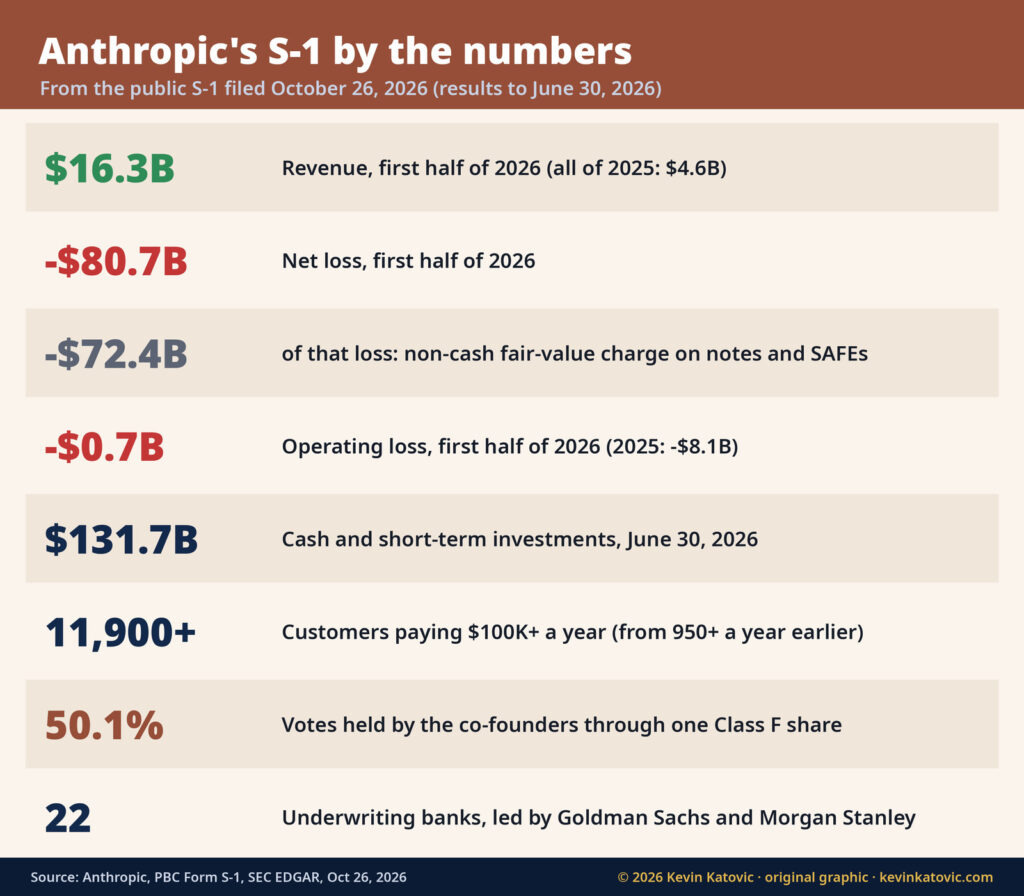
Revenue for the first six months of 2026 was $16.3 billion, against $4.6 billion for all of 2025. The net loss for the same six months was $80.7 billion, and $72.4 billion of that is a non-cash fair-value charge on convertible notes and SAFEs: the higher the company’s value went, the bigger that paper charge got. The actual operating loss was about $693 million, way down from $8.1 billion for 2025. I went through the loss line by line in my breakdown of where the $80.7 billion really went.
Other numbers that jumped out at me: $131.7 billion of cash and short-term investments on June 30, more than 11,900 customers paying $100,000 or more a year (up from about 950 a year earlier), and about 5,300 employees. The risk I would watch is the compute bill: the S-1 describes long-term take-or-pay commitments for chips and data centres that have to be paid whether or not they are used.
Who really controls ANT
This is the part retail buyers should read twice. One single Class F share, held by a company owned by the seven co-founders, carries 50.1% of the votes on general matters. The Long-Term Benefit Trust elects a majority of the board through Class T stock. Amazon and other strategic partners mostly hold non-voting Class N shares. Public buyers get Class A shares with one vote each, and Anthropic will be a Nasdaq “controlled company.” You are buying a piece of the economics, not a say in how it is run. Washington is a factor too, as the Pentagon’s fight over Claude as a supply-chain risk showed.
My Anthropic IPO price prediction
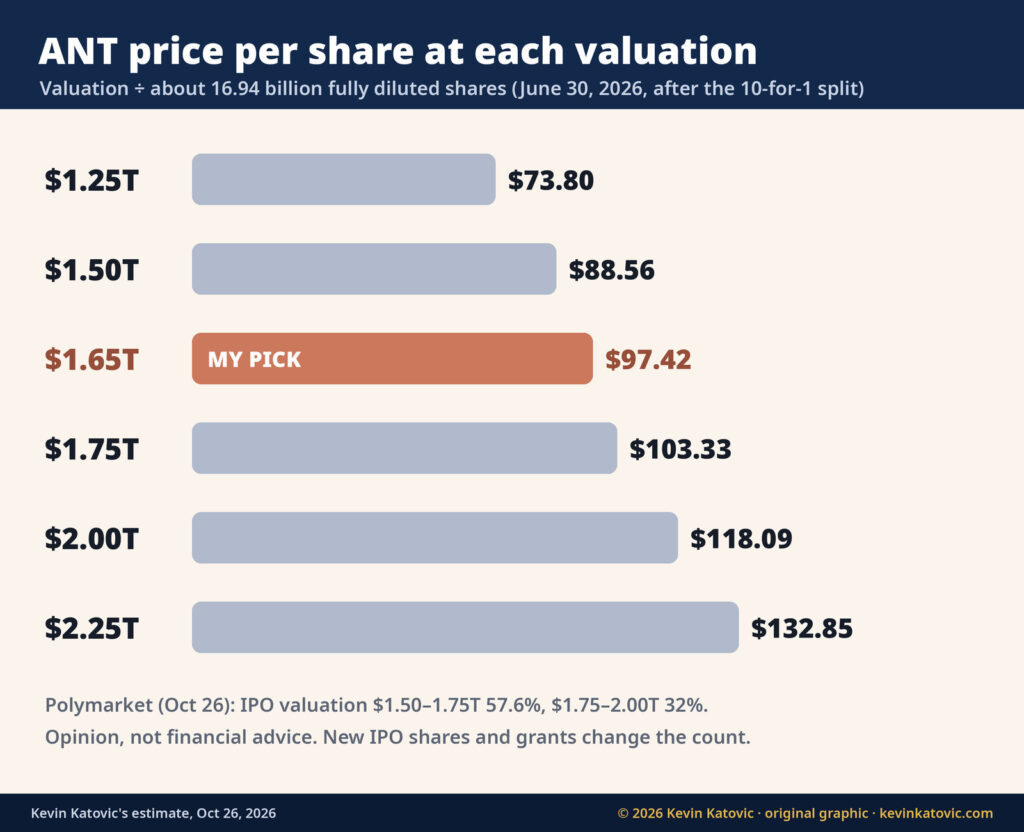
The S-1 gives one clean clue to the share count. Anthropic put 846,840,960 Class N shares into its public benefit fund and says that is 5% of its fully diluted shares as of June 30, 2026. That makes roughly 16.94 billion fully diluted shares after the split. Divide any valuation by that and you get a price per share:
- $1.5 trillion → about $88.56 a share
- $1.65 trillion → about $97.42 a share
- $1.75 trillion → about $103.33 a share
- $2.0 trillion → about $118.09 a share
Prediction markets agree with the middle of that table. On Polymarket on the morning of October 26, “$1.50T to $1.75T” was the favourite for the IPO valuation at 57.6%, with “$1.75T to $2.00T” at 32%. Traders also gave about 90% odds of a listing by November 30.
My call: a first price range somewhere around $90 to $100, pricing near the top at about $97 (roughly $1.65 trillion), and a first-day close above $105 if the market holds up. Banks like to leave room for a pop on a deal this size. The count will move, though: new IPO shares, employee grants since June 30 and any extra benefit-fund issuance all change the divisor, so treat the decimals as rough. For every step from here to pricing night, keep an eye on the live ANT ticker and pricing timeline I keep updated. My earlier post on why the Anthropic IPO price matters less than the real money still stands.
What happens next
- An amended S-1 with the price range and the number of shares.
- The roadshow, which can start no earlier than November 10.
- Pricing night, the evening before trading. That is the only real Anthropic IPO price.
- ANT starts trading on Nasdaq.
My take
After 147 days of waiting, the S-1 mostly confirms what the leaks said, which is a good sign: the revenue is real, the giant loss is mostly paper, and control stays with the founders and the trust. The price is the unknown, and I’m putting my marker down at $97. And if this IPO has you thinking about the hardware all that AI runs on, price out your own build in the AI Build Configurator.
This is my opinion and an estimate, not financial advice. IPO shares can fall below the offer price, and you can lose money.
Anthropic S-1 FAQ
Has Anthropic filed its S-1?
Yes. Anthropic, PBC filed its Form S-1 publicly with the SEC on October 26, 2026, after submitting a confidential draft on June 1, 2026.
What is Anthropic’s ticker symbol?
ANT. The S-1 says Anthropic has applied to list its Class A common stock on the Nasdaq Global Select Market under the symbol ANT.
What will the Anthropic IPO price be?
The S-1 leaves the price range blank. My estimate is about $97 a share, which works out to a valuation near $1.65 trillion on roughly 16.94 billion fully diluted shares. That is an opinion, not financial advice.
When will Anthropic start trading?
No date is set. The roadshow can start 15 days after the public filing, so from November 10, 2026, and most reports point to a listing in the second half of November.
Why did Anthropic lose $80.7 billion?
Most of the first-half 2026 net loss, $72.4 billion, is a non-cash change in the fair value of convertible notes, derivatives and SAFEs. The operating loss was about $693 million.
Sources: Anthropic, PBC Form S-1, filed with the SEC on October 26, 2026 (sec.gov EDGAR, CIK 0002130357); Anthropic’s October 26 announcement; Polymarket prices checked the morning of October 26, 2026. Share math is my own estimate. This post is independent and not affiliated with Anthropic.
Images: three original graphics by Kevin Katovic. © 2026 Kevin Katovic, all rights reserved. To license an image, email support@kevinkatovic.com.

AI-generated satirical illustration; fictional character